Retail Media Screens: How In-Store Digital Engagement Works

Engagis Australia
Engagis Australia combines strategy, technology, and creative expertise to deliver impactful digital signage and customer engagement solutions for leading brands across Australia.
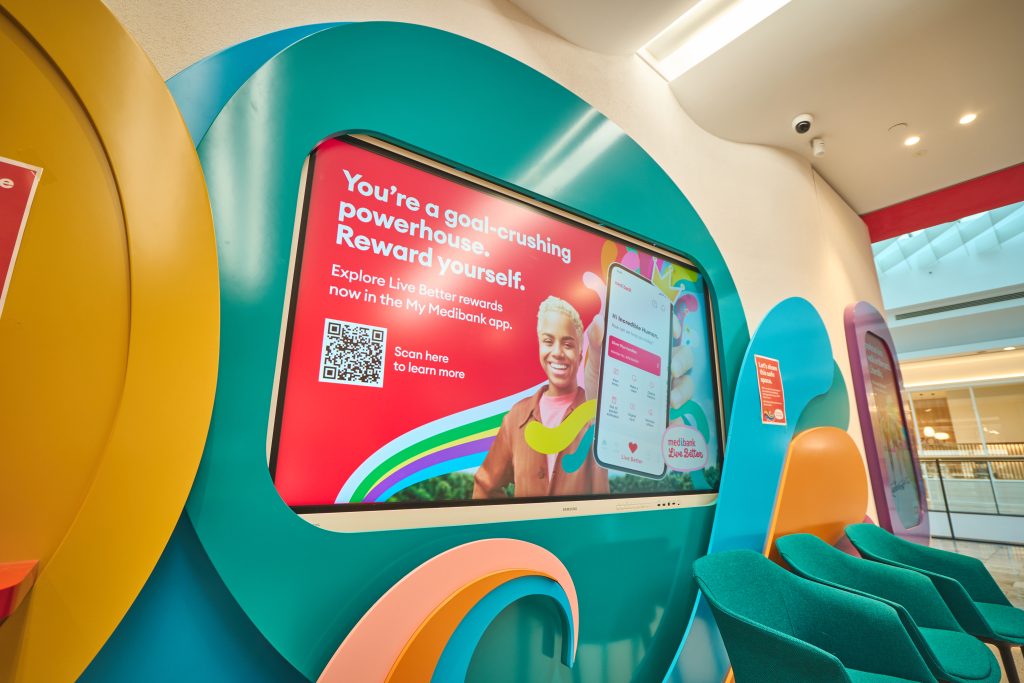
Retail media is the practice of turning a retailer’s owned channels, its website and app, its off-site advertising, and its physical estate of screens, shelf edges and store environments, into a measurable engagement channel, rather than just a place to display promotions. This piece focuses on the in-store side of that picture, since it’s the part of retail media growing fastest and understood the least. In Australia, it’s grown into an estimated $3 billion market, driven by Woolworths’ Cartology, Coles 360 and Bunnings’ Hammer Media. But the real shift is happening in-store: digital signage now actively shapes the customer journey, guiding attention at entry, influencing decisions at the shelf, and reinforcing messaging at checkout, in a way static signage never could.
Some of the largest private retail media networks in Australia sit well outside grocery. Banking, telco, pharmacy, QSR and fuel and convenience are all running in-branch and in-store screen estates at genuine scale, and Engagis works as digital engagement partner across those verticals. It’s proof that retail media isn’t just a grocery story: the businesses getting real value from in-store screens are the ones treating them as a performance channel, not a display cabinet.
How Do In-Store Digital Screens Work?
At a basic level, an in-store screen network is a set of displays, a content management system that schedules and pushes what appears on them, and a way to manage all of that remotely across however many locations you’re running. That’s the infrastructure layer and it’s the foundation our Media Management & Content Services are built around.
What makes it worth doing well is what sits on top of that infrastructure. Personalisation means what’s shown can change based on context, time of day, location within the store, even what’s happening in the world outside it. Content automation means that content doesn’t have to be manually rebuilt and re-uploaded every time something needs to change, it updates itself against rules you’ve set.
Done properly, this isn’t a screen showing the same loop on repeat. It’s a system that’s actually paying attention.
What Formats Does In-Store Retail Media Include?
Digital screens are the centre of gravity here, but they’re not the only tool in the kit. It’s worth knowing the full picture:
- Digital screens – large or small displays, video walls, shelf-edge or endcap placements. This is where most of the investment and most of the opportunity sits, and where choosing the right display hardware for the environment actually matters.
- Static signage – posters, shelf talkers, floor decals. Still has a place, still cost-effective, still worth planning around even as digital grows.
- Audio – in-store radio and announcements. A smaller category, but a powerful one for shaping the brand experience and atmosphere of a space.
- Interactive touchpoints – kiosks, scan-and-go devices, touch screens, wayfinding and more.
- Sensors and beacons – the layer increasingly sitting behind personalisation, feeding the kind of contextual data that makes targeted, context-aware messaging possible.
None of these formats compete with each other so much as they layer. The strongest in-store strategies use more than one.
What’s the Difference Between Retail Media and Traditional Digital Signage?
This is the question worth being precise about, because the two get used interchangeably and they’re not the same thing.
| Traditional Digital Signage | Retail Media (Engagis approach) | |
| Purpose | Display content | Improve customer experiences and enable monetisation of the network |
| Content | Static or manually scheduled | Personalised, automated, context-aware |
| Ownership model | Vendor sells hardware | Partner drives ongoing performance |
| Success measure | Uptime, screen count | Engagement, conversion influence, visual merchandising effectiveness |
| Relationship | Transactional | Ongoing partnership |
Vendors sell screens. Partners drive profitability. That distinction sounds simple, but it’s the whole difference between a business that installs hardware and one that’s actually accountable for whether the hardware does anything.
We’re straightforward about where we sit on that line, and straightforward about what we can and can’t promise. We don’t chase what’s trendy in this space for the sake of it, we invest in what’s coming while staying grounded in what already works.
How Does In-Store Fit Into Full-Funnel and Omnichannel Marketing?
It’s easy to think of in-store screens as a single, undifferentiated thing. In practice, they do different jobs depending on where a customer is in their decision.
Awareness
For someone with no prior intent, an in-store screen is a discovery tool. This is where cross-selling happens, or where a new product or service gets introduced simply because someone was standing in front of the right screen at the right moment.
Consideration
Once someone’s aware, screens can help them compare, understand, or get more confident in a decision they’re already leaning toward. This is where content automation earns its keep, the right information, automatically, without someone manually rebuilding it every time something changes.
Conversion
Right at the point of decision, timely or context-aware messaging can be the thing that closes it. This is the clearest link back to what we mean by “performance”; screens doing something measurable, not just something visible.
The other half of this is consistency. In-store screens shouldn’t be a separate universe from a business’s website, app or loyalty program, they should reinforce the same experience a customer’s already having elsewhere. Not because “omnichannel” is a buzzword worth chasing, but because a customer doesn’t experience a business in channels, they just experience the business.
How Is Retail Media Performance Measured In-Store?
This is the question that matters most, and it’s the question every business asking about in-store screens should be asking loudly.
Industry-wide, measurement is still the single biggest sticking point. In IAB Australia’s 2026 State of the Nation survey, 73% of brands and agencies said inconsistent metrics and definitions across networks were a real challenge, and measurement was the single most cited barrier to partnering, named by both brands (45%) and retailers themselves (48%). When brands were asked what actually matters when choosing a retail media partner, ad effectiveness measurement and performance tied as the top two answers, well ahead of audience reach, case studies, or cost-per-thousand pricing.
Here’s the part worth sitting with: in that same survey, only 32% of brands increased their in-store investment over the past year, and only 32% plan to next year, a lot lower than the 63-68% increasing spend on onsite and offsite channels. But 90% of retailers reported increased in-store revenue over the same period, second only to onsite. That’s a real gap.
In-store is quietly delivering while getting a fraction of the attention. That gap is the argument for taking it seriously.
Can a Bank or Service Business Run a Retail Media Network?
Grocery retailers got here first, and for understandable reasons. They had the footfall, the loyalty data, and decades of existing relationships with brands. But none of those ingredients is actually exclusive to grocery. What matters is having an audience, some kind of ongoing relationship with that audience, a physical footprint, and the ability to target within it. We work across banking, telco, pharmacy and other service-based verticals precisely because that’s true.
That’s true well beyond the supermarket aisle:
- Banking already has account-holder data, high visit frequency, and a captive, attentive audience in-branch. CommBank’s network is the existing proof this works.
- QSR has extremely high visit frequency and a naturally receptive audience making decisions in the moment.
- Fuel and convenience have volume, genuine dwell time at the pump or counter, and impulse-purchase behaviour built into the format itself.
- Pharmacy has trusted, repeat-relationship visits, and, especially as the Australian pharmacy landscape consolidates, a scale opportunity that’s only getting clearer.
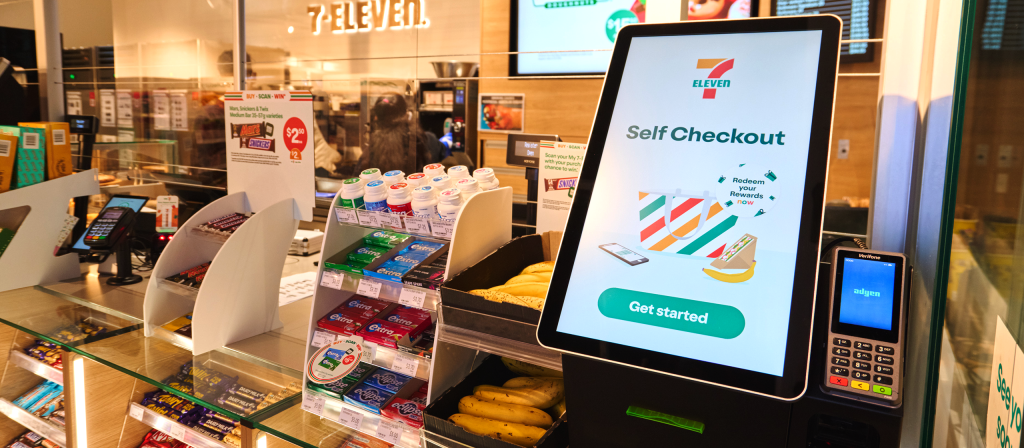
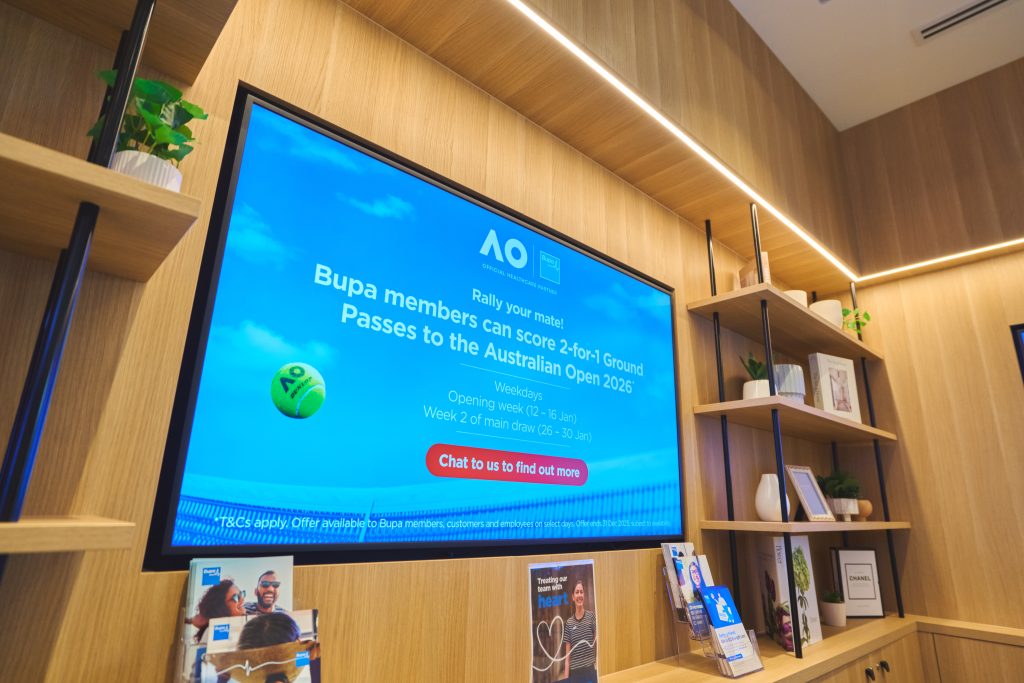
The real constraint was never “are you a retailer.” It’s “do you have a footprint, and a reason people keep coming back.” Most businesses answering yes to that second question have more in common with a supermarket than they think.
How Can Retailers Generate Additional Revenue From In-Store Screens?
Once a screen network exists and is doing its core job well, personalising messaging, automating content, measuring what’s working, it opens up a second, genuinely additive opportunity: letting other businesses use that same network, on commercial terms, to reach the same audience.
There are two distinct ways this works, and the distinction matters.
Endemic partnerships are the more familiar version, suppliers whose products already sit on the shelves in that store paying to be featured more prominently on screen. A grocery retailer’s own supplier relationships work this way already, in-store screens just make the placement dynamic and measurable rather than static.
Non-endemic partnerships are the less obvious opportunity, and the one most non-grocery businesses haven’t considered yet. This means selling screen space to complementary brands that don’t compete with, or even sell through, the retailer at all. The classic example is a home insurance brand advertising in a home improvement store, the products are unrelated, but the audience overlap is exact, and neither business competes with the other’s core offer.
This isn’t a new idea. Harrods built a genuinely significant non-endemic advertising business over roughly two decades, opening its screens to luxury travel and automotive brands with no product on Harrods’ own shelves, and non-endemic partners eventually made up around a quarter of its total advertising revenue. The same logic applies well beyond luxury retail: a bank’s branch network, a fuel and convenience footprint, or a pharmacy chain all reach audiences that plenty of non-competing brands would pay to reach too.
For a business running a screen network for the first time, endemic partnerships are usually the natural starting point, they build on relationships that already exist. Non-endemic is where the real incremental revenue tends to show up, but it depends entirely on being able to prove the audience and the outcome, which loops straight back to why measurement has to be solved first, not bolted on afterwards.
Worth noting from the current Australian market: IAB Australia’s 2026 data shows driving sales and conversions is now the dominant objective for retail and commerce media activity generally (89% of brands and agencies cite it), and proving effectiveness for advertisers whose products aren’t sold in-store is specifically flagged as one of the conditions for the next phase of growth in the category. In other words, the market is already validating this exact opportunity, it’s not a speculative add-on.
What’s Next for In-Store Retail Media?
We’d rather ground this in what’s actually happening than speculate about what might. In IAB Australia’s 2026 data, 72% of retailers and commerce media networks plan to expand in-store digital screen deployments over the next 12 months, and 84% plan to enhance their measurement offer specifically. That’s a category scaling up, not a trend-piece talking point.
On AI, it’s worth being precise about where the real near-term value is. Retailers surveyed see the biggest opportunities in data analysis and insights (68%) and audience targeting (64%), well ahead of anything conversational or agentic (44%). In other words, AI’s job in-store right now is making existing data more useful, not replacing the screen experience with something else entirely.
The Bottom Line
In-store screens aren’t a hardware category, they’re a performance channel, and they work best when someone’s actually accountable for whether they’re working. That’s the whole difference between a vendor and a partner.
In practice, that accountability is unglamorous but it’s the whole job. It’s 24/7 monitoring that catches a screen going dark before a store manager does. It’s proof-of-play reporting that can answer, specifically, what was live on which screen, in which store, at 3pm last Thursday. It’s a content team that gets a campaign onto every screen it’s meant to reach, on time, correctly, without someone internally having to chase it. None of that shows up in a sales pitch about screens. All of it shows up in whether a retail media network actually performs.
Practical Takeaways for Retailers
For retailers, the opportunity is not simply to add more screens. It is to make the screens already in the estate work harder, with clearer objectives, better content rules and stronger proof of performance.
- Start with the customer journey, not the screen count. Map where attention naturally happens in-store, then decide what each screen should do at that point: introduce, educate, compare, prompt or convert.
- Give every screen a job. Entry screens, aisle screens, service counters and checkout zones should not all run the same loop. Each location should have a clear role tied to the customer decision happening nearby.
- Build content rules before adding complexity. Decide which messages change by location, time of day, store type, campaign, stock availability or audience segment. Automation only works when the rules are commercially useful.
- Measure what actually matters. Proof-of-play is the baseline, not the finish line. Retailers should also look at engagement indicators, campaign uplift, product movement, conversion influence and the operational reliability of the network.
- Plan for support from day one. A screen that is blank, out of date or showing the wrong content damages the experience quickly. Monitoring, SLAs, spare hardware, content QA and escalation paths are part of the retail media product, not back-office administration.
- Separate first-party priorities from paid media opportunities. A network should first serve the retailer’s own customer experience and commercial goals. Once that foundation is working, endemic and non-endemic advertising can be layered in with clearer governance and stronger value for advertisers.
The retailers that get this right tend to treat in-store media as an operating model, not a campaign format. The screens matter, but the real value comes from the system behind them: the content strategy, the measurement framework and the partner accountable for keeping the network performing.
Frequently Asked Questions
What is a retail media network?
A retail media network turns a business’s owned channels – its website, app, off-site advertising and physical estate of in-store screens – into a measurable advertising and engagement channel. In-store, that means digital screens that actively shape the customer journey rather than simply display promotions.
How do in-store digital screens work?
An in-store screen network combines the displays themselves, a content management system that schedules and pushes content, and a way to manage it all remotely across every location. Personalisation and content automation sit on top, so what’s shown changes by context, time of day and location without being manually rebuilt each time.
What’s the difference between retail media and traditional digital signage?
Traditional digital signage displays content and is judged on uptime and screen count. Retail media is personalised, automated and context-aware, and is judged on engagement, conversion influence and visual merchandising effectiveness.
How is retail media performance measured in-store?
Proof-of-play reporting is the baseline – confirming what was live on which screen, in which store, at what time. Beyond that, retailers look at engagement indicators, campaign uplift, product movement, conversion influence and network reliability. Consistent measurement remains the industry’s biggest challenge, according to IAB Australia’s 2026 data.
Can a bank or service business run a retail media network?
Yes. Any business with an audience, an ongoing relationship with that audience, a physical footprint and the ability to target within it can run one – not just grocery retailers. Banking, QSR, fuel and convenience, and pharmacy all have the visit frequency and dwell time that make in-store screens work.
Ready to Make Your In-store Screen Network Work Harder?
Get in touch with Engagis to discuss how we can help you plan, manage and measure a retail media network that performs.
You Might Be Interested In
Digital Signage Solutions: A Complete Guide
Cloud-Based Digital Signage: Security, Uptime and Governance for Enterprise Networks
LED vs LCD Advertising Screens Compared
Your Digital Signage & AV Starts Here
Get expert guidance, reliable delivery, and ongoing support - end to end. Talk to our team about solutions tailored to your organisation.